Insights gathered from Pascal Dhermy, Radio Systems Engineer at Systrans, an Equans company.
In the public transit sector, where every second counts and passenger safety is paramount, the quality of communication between operational teams represents a major strategic challenge. While TETRA technology has long dominated the mission-critical communications market, a new international standard is gradually emerging as the solution of the future: MCPTT (Mission Critical Push-To-Talk).
This technological evolution is more than just a simple upgrade; it represents a paradigm shift in the way transit operators and local authorities communicate, coordinate their teams, and ensure the safety of their networks. Several major French cities have already leaped, joining police and law enforcement agencies that use this technology on a daily basis.
What exactly is MCPTT?
Scope
Like TETRA or DMR, MCPTT is a leading international standard developed by ETSI (European Telecommunications Standards Institute) and 3GPP (3rd Generation Partnership Project) for mission-critical communications. This technology enables the exchange of voice, data, and video over mobile networks, whether public or private.
Unlike traditional radio systems, which require dedicated and costly infrastructure, MCPTT primarily relies on existing public LTE (Long-Term Evolution) IP networks, which brings many advantages:
- no need to build costly radio infrastructure.
- nationwide coverage already in place.
- high bandwidth (enables video, HD photos, etc.).
- evolution to 5G without changing everything.
This shared LTE infrastructure provides unprecedented flexibility and scalability.
“It’s a system that was initially developed for public safety services but is perfectly suited to public transportation networks,” explains Pascal Dhermy, Radio Systems Engineer at Systrans, an Equans company.
Core Principles of MCPTT
MCPTT is built on three essential pillars:
- High-level security of operational communications (CYBERSECURITY)
MCPTT communications benefit from end-to-end encryption and strong authentication, ensuring the confidentiality of sensitive exchanges. This enhanced cybersecurity meets the strictest requirements of mission-critical services. - Full interoperability.
One of MCPTT’s key strengths is its ability to connect different teams, different equipment, and different infrastructures. Whether you use smartphones, tablets, or dedicated terminals, the system enables seamless communication between all stakeholders.
Why is MCPTT gaining traction in public transportation?
Concrete benefits for public transit operators
- Supporting software migration to new systems
MCPTT integrates seamlessly with the NAVINEO Computer-Aided Dispatch, Automatic Vehicle Location and passenger information system (CAD/AVL) from Systrans, an Equans company, thus facilitating the digital transition of transportation networks. This complementarity allows operators to modernize their communication infrastructure without disrupting their entire technical ecosystem. Thanks to APIs, MCPTT can exchange data with the CAD/AVL system: vehicle location, communication status, real-time alerts…
This interoperability makes it possible to create a truly consistent digital ecosystem, where all components interact to optimize network operations and improve overall efficiency. - Instant and reliable communications
In the public transportation context, responsiveness is critical. MCPTT offers low latency, ensuring near-instant communication between field agents, control centers, security teams, and maintenance crews. This performance is especially valuable during incidents or emergency situations. - Radio coverage
When using one or more public LTE operators, radio coverage becomes nationwide and even international, depending on the type of subscription selected.
Similarly, the use of Wi-Fi extends coverage into areas not covered by LTE (inside buildings, for example). - Improved operational efficiency
Thanks to better coordination of flows and teams, MCPTT helps optimize day-to-day network management. Advanced features such as GPS geolocation, file sharing, and text messaging significantly enhance communication capabilities compared to traditional radio systems. - 24/7 availability
MCPTT provides continuous availability, which is essential to ensure service continuity and passenger safety at all times.
Specific advantages for local authorities
Enhanced cybersecurity
At a time when cyber threats are multiplying, local authorities must protect their critical infrastructure. MCPTT offers a high level of cybersecurity through several advanced mechanisms:
- Encryption of communications to ensure confidentiality.
- Strong authentication to secure system access.
Controlled investment // SAAS and ON-PREMISE solutions
Unlike traditional radio systems, which require deploying and maintaining dedicated radio infrastructure, MCPTT relies on a virtualized core network and primarily on a managed radio backbone. This approach significantly reduces long-term investment and maintenance costs.
Architecture and operation: a modern and flexible solution
Fully virtualized architecture
System administration and configuration are carried out through a WEB interface.
This interface allows user rights to be defined based on profiles, individual and group numbering plans, as well as PTI (lone worker) options.
“There are two options,” explains Pascal Dhermy: “either the system is hosted in a public or private data center, or it is hosted on the customer’s premises.”
This flexibility allows each organization to choose the model that best suits its constraints:
SaaS hosting (Software as a Service):
- Monthly subscription.
- Mhandled by the operator
- No heavy infrastructure to manage.
- Ideal for organizations that want to outsource technical management.
- On-premise hosting:
- Initial investment in hardware
- No recurring subscription
Full control over the infrastructure - Recommended for organizations with structured IT teams.
The technology is scalable: it can be deployed across a few dozen terminals or several thousand. SaaS models allow mid-sized networks to get started without heavy infrastructure, with gradual scaling.
Cutting-edge technology
MCPTT integrates several technological innovations:
- ETSI/3GPP compliant system: alignment with international standards.
- High throughput: transmission of large data (photos, videos, maps).
- No APN required: simplified configuration on public or private LTE networks.
- AI-driven audio capture: intelligent background noise suppression for maximum clarity, even in noisy environments.
- Advanced geo-fencing: automatic group assignment and message transmission based on agents’ geographic position
Advanced features: beyond simple voice communication
Calls and communications
MCPTT goes far beyond the capabilities of a simple “digital walkie-talkie”:
- One-to-one calls in full-duplex (standard conversation) or half-duplex (push-to-talk).
- Static group calls (predefined teams) or dynamic group calls (created on the fly).
- Priority and preemption management: some communications can override others depending on urgency.
- Emergency calls with a dedicated SOS button on terminals.
Safety and lone worker protection
The PTI (Lone Worker Protection) feature is particularly valued in the transport sector:
- Automatic distress alert in case of a fall or prolonged immobility.
- Ambient listening during a PTI to assess the situation.
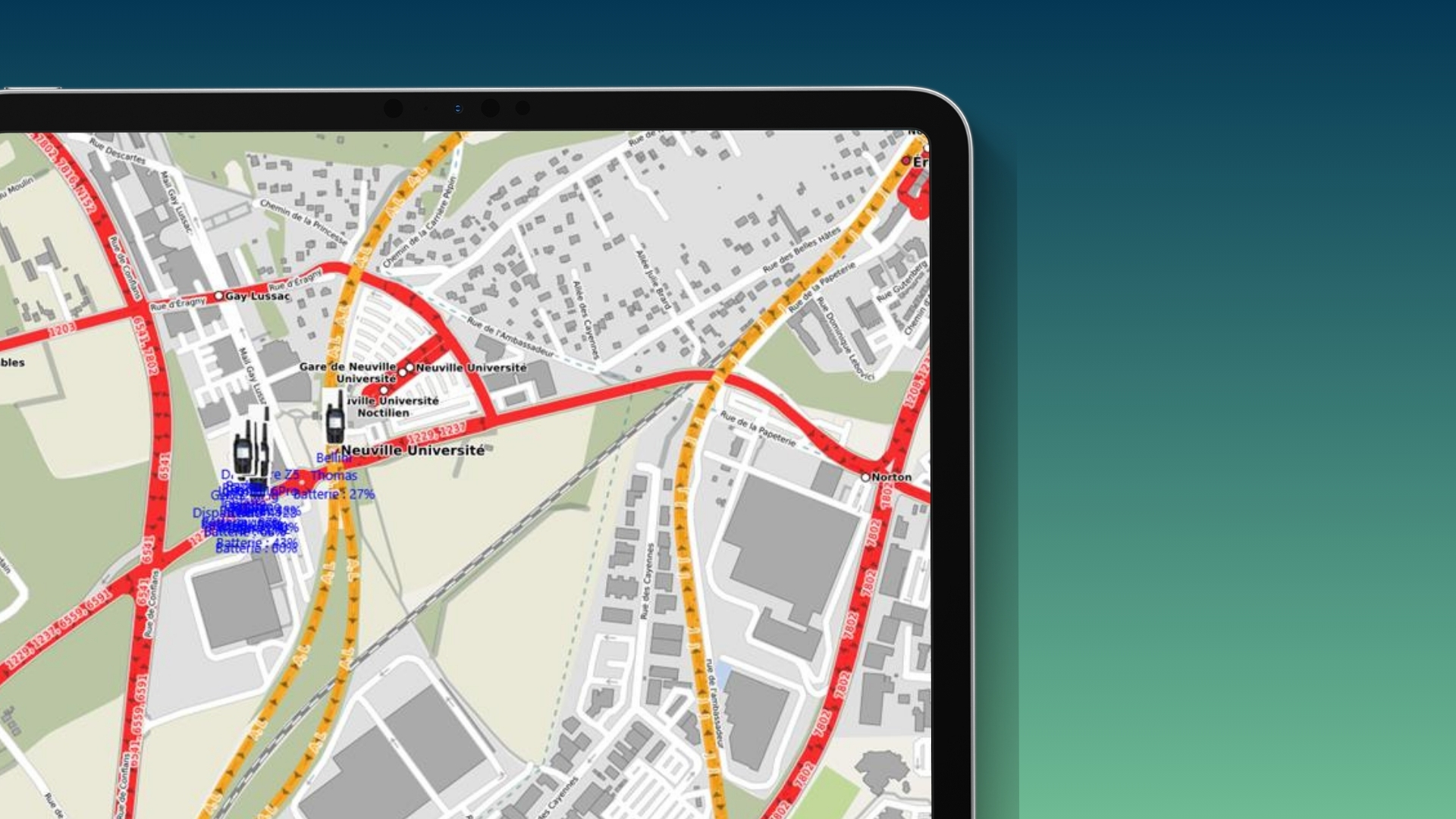
- Precise GPS location of the distressed worker with immediate display on integrated mapping on receiving devices.
Coordination tools
- Sending text messages: complementary to voice communication.
- Sending attachments: photos, maps, technical documents.
- Callback requests with priority levels (normal/urgent).
- Ambient listening: remote monitoring of an area or vehicle.
- Scan list: automatic monitoring of multiple groups with switching to the active group.
Exceptional audio quality
The integration of artificial intelligence into audio processing represents a major breakthrough. The system automatically removes background noise (engines, public announcements, construction), ensuring optimal communication clarity even in the noisiest environments.
Ongoing deployments
Several French transportation networks have already adopted MCPTT. Without being able to disclose their names for confidentiality reasons, Pascal Dhermy shares a few key insights:
In a mid-sized urban area, deployment started with around 70 terminals. The teams already had an older radio system and had moved to voice over IP. They needed more advanced portable devices, which led them to choose the MCPTT solution.
A second case in France is also telling. While deploying the advanced version of the NAVINEO CAD/AVL system, another French transport network took the opportunity to directly integrate MCPTT into its new infrastructure. The full monitoring feature, allowing the control center to oversee all communications, was a decisive factor in their choice.
Conclusion
MCPTT technology represents a strategic opportunity for transport operators and local authorities to deeply modernize their operational communications.
In conclusion, while MCPTT is now a key first step in the transition to broadband mission-critical communications, it is only part of a broader movement. The ecosystem is rapidly evolving toward MCX (Mission Critical Services), which seamlessly integrate voice (MCPTT), video (MCVideo), and data (MCData) within a unified and standardized environment.